The day I realized I wanted to do a job I didn't know existed
A year ago, we were still working on Symphony of Cards (SoC). You know, the project we eventually "cut" – we told you about it here:
 Parallel-Minds Teams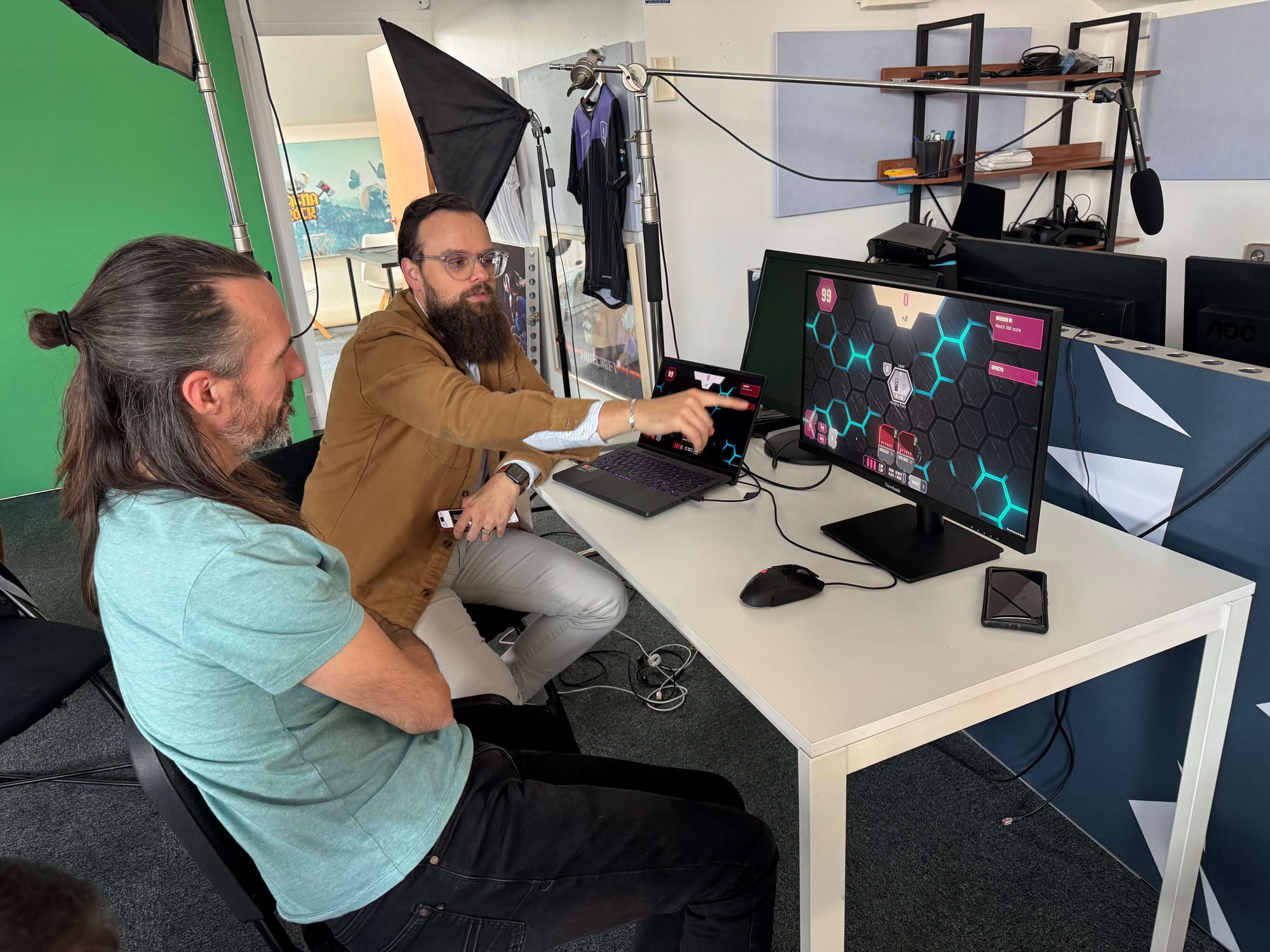
While we were juggling gameplay design, administrative tasks, and entrepreneurial duties, I took some time to explore UX/UI and visual implementation in Unity. To learn, to see what it was like... And very quickly, I understood something: I love this!
The Creative Revelation
A year earlier, I had already felt that something was missing from my professional journey. The creative dimension. Artistic, even. This fuzzy feeling turned into clarity. Then into necessity.
I got my hands dirty. GameObjects, prefabs, cameras, render textures, canvas... I loved manipulating all these layout and composition parameters. It definitely reminded me of my web dev years.
But the real click? Drumroll... Shaders and VFX graphs.
The Gears Start Turning
At first, it was just stimulating to arrange these little boxes and connect them. Then I realized the power of these tools. The infinity of possibilities. You know that GIF with the guy making a supernova explode out of his brain? 🤯 Well, that was the feeling.
To avoid going off in all directions, I took concrete cases. Textbook cases, cases applicable to our project. I browsed forums, watched tutorials, with the goal of knowing how to reproduce these visual effects. I mentioned school just before – that's totally it! I'm back into equations, curves, trigonometry, vector calculations, etc. And surprisingly, when you apply this for concrete and immediate results: it works better, I wanted to review all of it!
So I created playing cards that shimmered. Translucent. Refracting light. With spatial effects impossible in our poor 3-dimensional universe (ahahah), etc.
I created a whole bunch of shaders for our hexagonal grids. (You're starting to understand that we love hexagons, right?)
The "Woah Effect"
Then, VFX. Big plus: almost everything I had learned about shaders translates directly. I connected a small box to a bigger one [...] Then to another. I pressed "PLAY". Woah! It was insane. Ultra-satisfying. Even orgasmic (yeah, I'm exaggerating a bit).
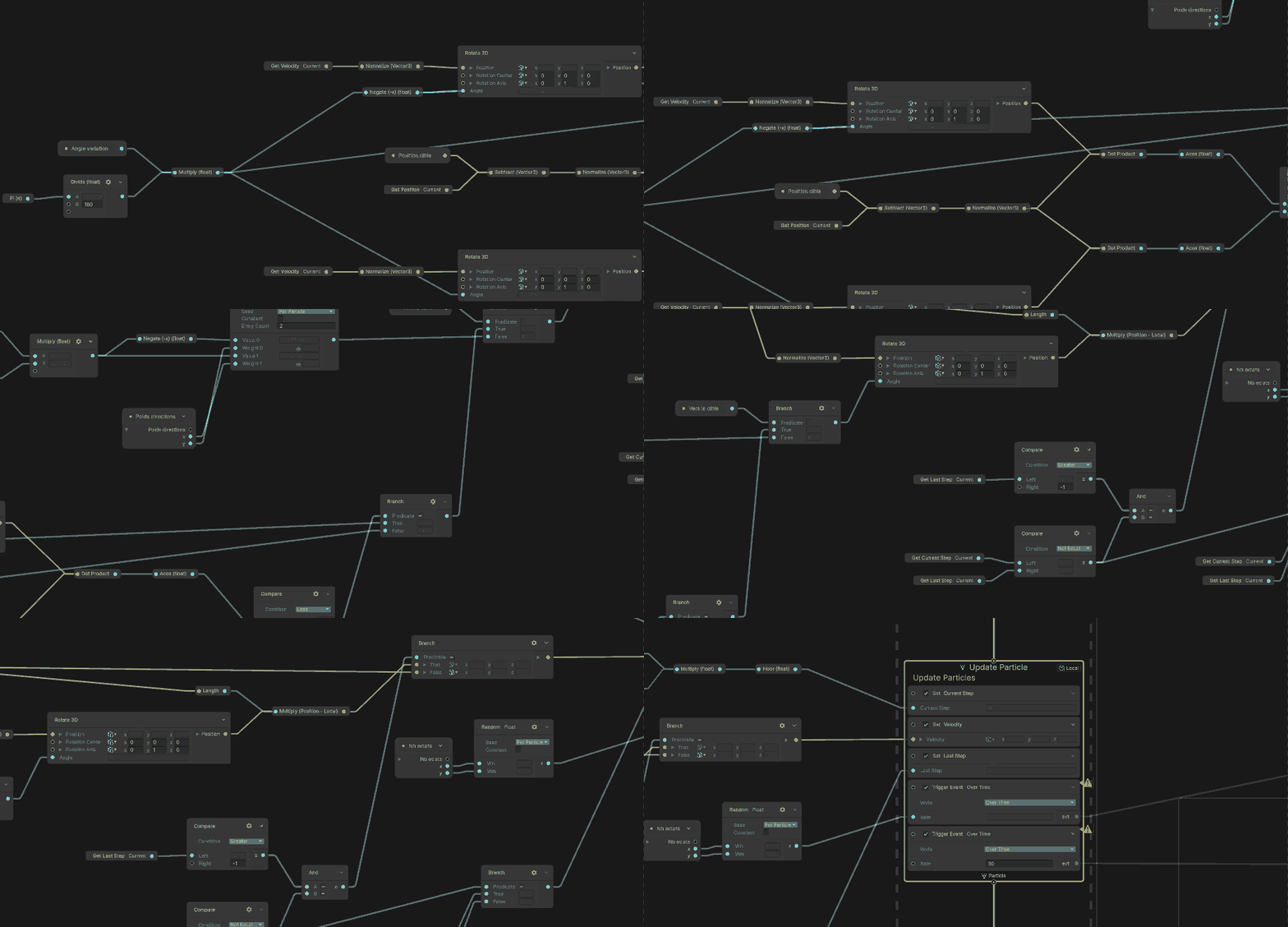
Actually, it's a whole discipline, I told myself. But wait...🤔 I turned around, my eyes landed on a big magazine that had been lying around for a while. It's a book that describes careers in the video game industry (which I had picked up during my visits to gaming schools). I flipped through the pages and there, bam! (that's not the right onomatopoeia). I get to the letter "T", there's a job for this... Ho-ly shit, TECH ART! It has a name!
Obviously, I immediately added Tech Artist to my list of dream jobs. And boom, it lands directly between Photograph and Waterslide Tester.
When Sound Meets Image
On the side, for SoC, we had undertaken research on musical and rhythmic implementation. It was the major challenge of the project.
Will created VST prototypes for DAW... Okay, too much technical jargon there. I'll let him explain that in another article 👉 [link to insert] (as if I'm going to remember that later...).
All that to say we quickly asked ourselves: how do we make sound and image interact in Unity?
And there, you see me coming with my high horses (thank you for indulging my mixed metaphors).
— Hey me! Hey me! (like a kid in front of the Christmas tree on the morning of December 25th)
The Result
So, I made this:
Wait. Do you have 4 minutes? Before you start, grab your headphones, turn the volume all the way up, and turn off the lights.
VFX Cubes Tunnel - Procedural Audio to Visual, create on Unity, VFX Graph
(Normally when you come back to the real world, you'll observe an optical illusion for a few seconds where your central vision is spherically distorted)
This is a creation that adapts entirely procedurally to the sound frequency bands I send it. It's part of a series (if you like it, I'll publish others) – I promise I'll talk to you later about procedural generation because it's also a revelation for me – In any case, while making it, I realized I had just recreated a visualization system I loved to contemplate in my youth: Milkdrop, a visual plugin for Winamp (audio player for computers that marked its era).
Sometimes it's crazy how everything connects and seems obvious. It was there, somewhere, surely in a corner of my mind.
In summary: science, physics, math, and visual art <3
See You Soon
If you, reader, make sound and want "geometric-abstract" reactive visuals, come on, let's talk!
And in the meantime, register your best score on the leaderboard of our Cascade prototype:

Best regards and see you very soon.
Marc

Comments ()